Howl's Moving Castle: A "Home" Architecture
In one of Studio Ghibli’s beautiful productions, “The Howl’s Moving Castle,” the author, through his characters, explores the concept of space attachment and the design of “home” in a diverting way.
The story starts with a girl named Sofie. A very ordinary girl in her context, bound to her growing place and yet an outsider to it. Content with where she is, she never seemed to declare her wanting of a refuge, not even to herself.
Like every other storyline, growth is provoked by hardships: A war, the encounter of a young wizard, and a passing aging curse. This is what drives little Sofie out of her coop into the world, finally seeking to belong. Her quest leads her to Howl’s castle, a moving entity of irregular volumetry.
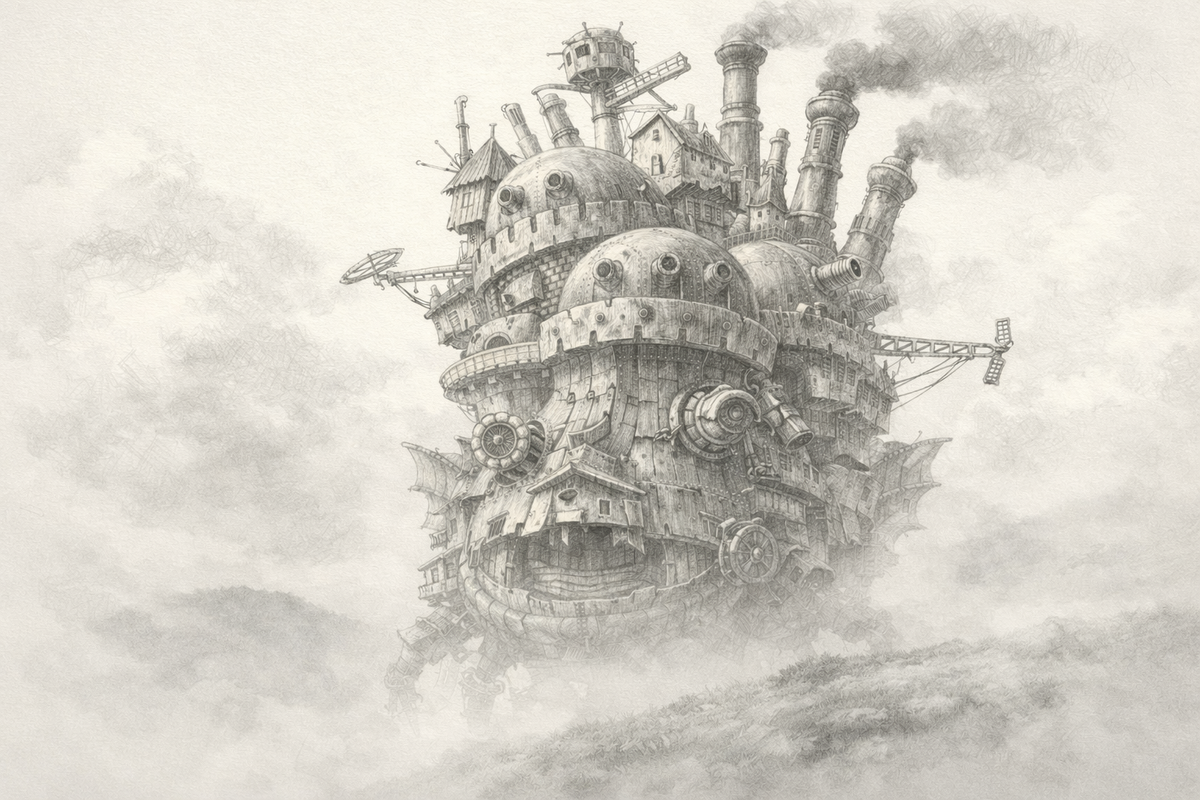
The Anatomy of Howl’s Castle
At first sight, Howl’s Castle can seem a malformed beast, with its anatomical structure: legs, eyes, mouths… that allows it to move around. Upon a closer inspection, you see that it’s a merger of houses, metamorphosed into one aesthetically eccentric structure.
Before Sofie’s intervention, the interiors are no different: rogue and eclectic, as if the mixing of houses, styles, and the hoarding of valuables (as in Howl’s bedroom) is a frail attempt to bring a homely sense to the castle.
However, the agile and enchanting nature of the castle makes it a great place to settle. Grounding and yet spatially detached, it allowed for a constant change of scenery and animation.
Calcifier: the incarnation of genius loci
Calcifier, the enflamed demon, is responsible for keeping the castle together, moving it around, and changing its inner layout. Being directly connected to Howl – by heart - it maintains the warmth his master comes back to, and everyone gathers around, thus sustaining its flame. It’s a home-made sustainable ecosystem where fire doesn’t burn. Instead, it builds and personifies the space: it's the genius loci.
The domestication of the castle
The interior of the castle undergoes several major layout changes. First, as Sofie settles in, she navigates the chaos and adds a grounding sense to the mobile home through cleaning, cooking, and rearrangement. After she bonds with the rest of the residents, Howl uses its inflamed heart to change it into her image: homely and convivial.
Greenery for revival: Lastly, after the great rebuild of the castle, a backyard is set up —a piece of earth to bind the eccentric architecture to—verdure here and there, signaling the formation of a new structure, both tangible and emotive.
The advantages of the Howl design
In and within space: The Howl design simultaneously allows both space attachment and detachment. You are still bound to your personalised grounding architecture, but one that’s portable and integratable in different contexts and environments.
Agile architecture: the castle morphs its layout and reorganises to adjust to the shifting needs of its residents and the places it settles in, offering a sustainable user experience.
Maximalism on display: The anarchic exterior mirrors the eclectic interiors of the castle. With Howl’s Room walls covered in jewels, he sure encourages spatial character and the abundance of self-expression within.
A space for all and space for one: even when living in a castle, personal space is a prerequisite in home design. There, behind one unmarked door, Howl leads Sophie to his once “safe space”— a cottage hideaway for her to be alone.
Beyond the visuals, this beautiful depiction explores a philosophical question that, for a long time, architects and anthropologists tried to answer. A dilemma similar to the “chicken or the egg.” What comes first? The home or the family? What inspires or catalyzes the forming of the other? To that, the Howl model suggests that a family is what makes a home out of a house. And a house is a vessel in which the family forms and bonds, consequently, turning it into a home.